Parts Experts
 Fast Shipping
 Aussie Owned
 Best Prices









































Dual Battery Systems for 4x4: Complete Redarc and Itechworld Setup Guide
Dual Battery Systems for 4x4: Complete Redarc and Itechworld Setup Guide
Ask any experienced 4WD tourer what they wish they had done sooner, and a dual battery system comes up every single time. Trying to run a fridge, lights, charging, and communication gear off a single starting battery isn't just inconvenient. It's a genuine risk. Get it wrong and you're stranded with a flat battery 300km from the nearest town.
This guide covers everything you need to know about 4x4 dual battery systems: why you need one, how they work, the key differences between DC-DC chargers and VSRs, and the best products from Redarc and Itechworld to build a system that performs.
Why You Need a Dual Battery System
The Core Problem: One Battery Cannot Do Two Jobs
Your vehicle's starting battery has one job: deliver a massive burst of current to start the engine, then be immediately recharged by the alternator. It is not designed to be slowly drained over hours by a fridge, lighting, or USB chargers. Deep discharging a starting battery below 50% repeatedly degrades it quickly and risks a no-start scenario at the worst possible time.
A dual battery system adds a second, dedicated house battery (auxiliary battery) to power your accessories. This battery is specifically designed to be discharged deeply and recharged repeatedly. That is exactly what running a touring fridge for 24 hours demands.
What a Dual Battery System Enables
- Running a 12V fridge indefinitely without risking your starting battery
- Powering LED camp lights, phone chargers, laptop chargers, and other accessories from camp
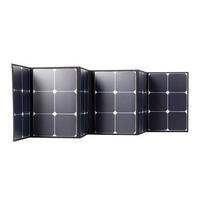
- Charging from solar panels via an intelligent MPPT controller
- Running communication gear (UHF, sat phone, EPIRB) at full power
- Peace of mind that your engine will always start, regardless of accessory usage
How It Works: DC-DC Chargers vs VSR
This is the most important decision in dual battery design, and unfortunately the one most commonly misunderstood. There are two primary methods for charging your auxiliary battery from the vehicle's alternator: Voltage Sensitive Relays (VSR) and DC-DC chargers. They are not equivalent, and the difference matters.
Voltage Sensitive Relay (VSR)
A VSR is a simple, inexpensive device that monitors voltage on the main battery circuit. When the starting battery reaches a certain voltage (typically 13.7V, indicating the alternator is running), it closes a relay connecting the two batteries in parallel and allows current to flow into the auxiliary battery.
The problems with VSRs:
- Modern smart alternators (found in most post-2015 vehicles) reduce voltage output when they sense a full battery. The VSR never gets a sustained high voltage signal, and the auxiliary battery rarely achieves a full charge.
- VSRs provide no current regulation and cannot properly manage the charging of modern lithium (LiFePO4) batteries.
- A VSR with a deeply discharged auxiliary battery can overload a modern smart alternator.
VSRs are outdated technology for modern 4WDs. If your vehicle was built after 2015, a DC-DC charger is the right choice.
DC-DC Charger: The Right Choice
A DC-DC charger (also called a Battery-to-Battery charger) is an intelligent electronic device that takes input voltage from the vehicle's electrical system and converts it to a regulated, controlled output to charge the auxiliary battery properly.
Why DC-DC chargers are superior:
- Smart alternator compatible: Works correctly with modern variable-voltage alternators, drawing a consistent, manageable current regardless of alternator output voltage.
- Multi-stage charging: Charges in bulk, absorption, and float stages, which is exactly what deep-cycle batteries need to achieve a full charge and maximise battery life.
- Solar MPPT integration: Premium DC-DC chargers like the Redarc BCDC range combine the DC-DC charger with an MPPT solar regulator in a single unit, maximising solar panel efficiency and simplifying wiring.
- Battery chemistry compatibility: Supports AGM, flooded lead-acid, and lithium (LiFePO4) chemistries with appropriate charge profiles.
- Protects both batteries: Intelligent isolation ensures the starting battery is never compromised by the auxiliary system.
Bottom line: If you are installing a dual battery system today, use a DC-DC charger.
Redarc: The Australian Benchmark for DC Power
Redarc Electronics is a South Australian company and the undisputed leader in Australian DC power management for 4WDs. Founded in 1979, Redarc engineers, manufactures, and tests their products in Australia. Their BCDC range is the most widely recommended redarc dual battery charger in the country, backed by genuine Australian support and an extensive dealer network.
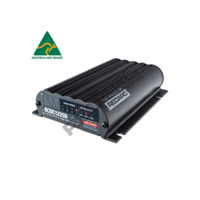
Redarc BCDC1225D - 25A (Most Popular)
The Redarc BCDC1225D is the sweet spot for most 4WD touring setups. It manages 25A combined input from the alternator and solar, delivering maximum charge rate to the auxiliary battery.
- 25A DC output plus 20A solar MPPT input
- Compatible with smart alternators
- Supports AGM, Calcium, Gel, and Lithium (LiFePO4) batteries
- IP67 waterproof rated
- Green Power mode powers accessories directly from solar without battery charging losses
For a single 100Ah-200Ah auxiliary battery with 200W of solar, the BCDC1225D is the ideal choice. It is the most commonly installed dual battery system 4x4 charger in Australia for good reason.
Redarc BCDC1240D - 40A (High-Demand Setups)
The Redarc BCDC1240D steps up to 40A for larger battery banks, high-capacity solar arrays, or setups running multiple fridges and significant accessory loads.
- 40A DC output plus 30A MPPT solar input
- Significantly faster charge times for large battery banks
- Ideal for setups with 300W+ solar and 200Ah+ battery banks
Redarc BCDC1250D - 50A (Expedition Builds)
The Redarc BCDC1250D delivers 50A output for large multi-battery setups, camper trailers, and expedition builds with 400W+ solar. This is the choice for tourers who need fast recharge times for large lithium battery banks.
Itechworld: Smart Lithium Batteries Built for 4x4
Itechworld is an Australian battery brand engineering LiFePO4 (Lithium Iron Phosphate) solutions specifically for the 4WD, caravan, and off-grid market. Their batteries pair exceptionally well with Redarc BCDC chargers, offering significant advantages over traditional AGM batteries in weight, capacity, and lifespan. Car Mods Australia now stocks a full range of Itechworld products to complete your dual battery system 4x4 build.
Itechworld iTECH50SS Super Slim Lithium Battery (50Ah)
The iTECH50SS is designed for utes, 4WDs, and canopy setups where space is tight. At just 70mm wide, it fits where standard batteries simply will not go.
- 50Ah LiFePO4 with 100% usable capacity
- Super slim 70mm profile using advanced prismatic cell technology
- Bluetooth monitoring via the iTechworld Connect app
- Integrated Battery Management System (BMS) with auto cell-balancing
- Drop-in replacement for AGM batteries in tight canopy builds
- 5-year Australian warranty
Itechworld iTECH300X PRO Lithium Battery (300Ah)
For serious tourers who need maximum capacity without the weight penalty of AGM, the iTECH300X PRO delivers 300Ah of LiFePO4 power in a package weighing just 26.3kg. Compared to equivalent AGM capacity, that is a weight saving of over 190kg.
- 300Ah LiFePO4 with 100% usable capacity (effectively 300Ah vs roughly 150Ah from a comparable AGM)
- IP67 dust and waterproof rated
- Charges from 0 to 100% in approximately 2 hours with a compatible 150A charger
- Bluetooth monitoring via the iTechworld Connect app
- Expandable in parallel for larger battery bank configurations
- Engineered and developed in Australia
Paired with a Redarc BCDC1225D or BCDC1240D, the iTECH300X PRO forms one of the most capable and weight-efficient redarc dual battery system builds available for extended touring.
Itechworld Power Core 200Ah Ultra Slim All-in-One System
For those who want the simplest possible installation, the Itechworld Power Core 200Ah integrates a 200Ah lithium battery with system management in a single ultra-slim unit. It removes the complexity of multi-component builds while delivering clean, reliable power for fridges, lighting, and accessories. This is an ideal choice for clean canopy installs where space efficiency is a priority.
Sizing Your System
Use this guide to size your battery and charger correctly before purchasing.
Step 1: Calculate Your Daily Power Budget
- 12V fridge (40L): 30-50Ah per day
- Phone charging (2 phones): 5-10Ah per day
- LED camp lights (3 hours): 5-10Ah per day
- UHF radio (standby): 2-3Ah per day
- Laptop charging: 15-30Ah per day
A typical touring couple runs 60-100Ah per day in total.
Step 2: Size Your Battery
Your battery should cover at least 2 days of consumption without recharging (in case of extended cloudy periods). Double your daily consumption for the minimum battery size.
- 70Ah per day: minimum 140Ah (or 100Ah lithium, which offers 100% usable capacity)
- 100Ah per day: 200Ah AGM or 120-150Ah lithium recommended
Step 3: Size Your Solar
200W of solar provides roughly 60-80Ah on a clear Australian day. For a setup consuming 80Ah per day, 200W covers most sunny days. Add more panels for consistently overcast conditions or higher consumption loads.
Installation: DIY vs Professional
A dual battery system installation involves significant wiring work: heavy-gauge cable runs, fuse sizing, correct connections to the vehicle electrical system, and potentially integration with existing accessories. For most people, professional installation by an auto electrician is strongly recommended.
DIY is feasible if you have experience with automotive 12V wiring, understand fuse sizing and cable ratings, can read a wiring diagram, and have appropriate crimping tools and a multimeter.
Professional installation is recommended if you are not comfortable with automotive electrical work, your vehicle has a modern smart alternator (most post-2015 vehicles), you are installing a lithium battery with specific charging requirements, or cables need to run through the firewall or under the vehicle.
A professionally installed dual battery system 4x4 with a Redarc BCDC charger and 100Ah lithium battery typically costs $1,200-$2,500 all-inclusive (parts and labour), depending on vehicle complexity and cable runs. Lithium setups sit at the higher end of this range but offer a longer service life and lower total cost of ownership.
Shop Dual Battery Systems at Car Mods Australia
Ready to build your dual battery system? Browse our full range of 4x4 power management products:
- Redarc BCDC1225D 25A DC Battery Charger
- Redarc BCDC1240D 40A DC Battery Charger
- Redarc BCDC1250D 50A DC Battery Charger
- Itechworld iTECH50SS 50Ah Super Slim Lithium Battery
- Itechworld iTECH300X PRO 300Ah Lithium Battery
- Itechworld Power Core 200Ah Ultra Slim All-in-One System
Unsure what system is right for your setup? Our team can help you spec out a dual battery system 4x4 build that matches your vehicle, battery chemistry, and touring style. Get in touch. We love helping people get this right the first time.